Authenticity Begins at the Source
Food, family, wine—and what happens when you start asking where things really come from.
It started with a conversation about dinner.
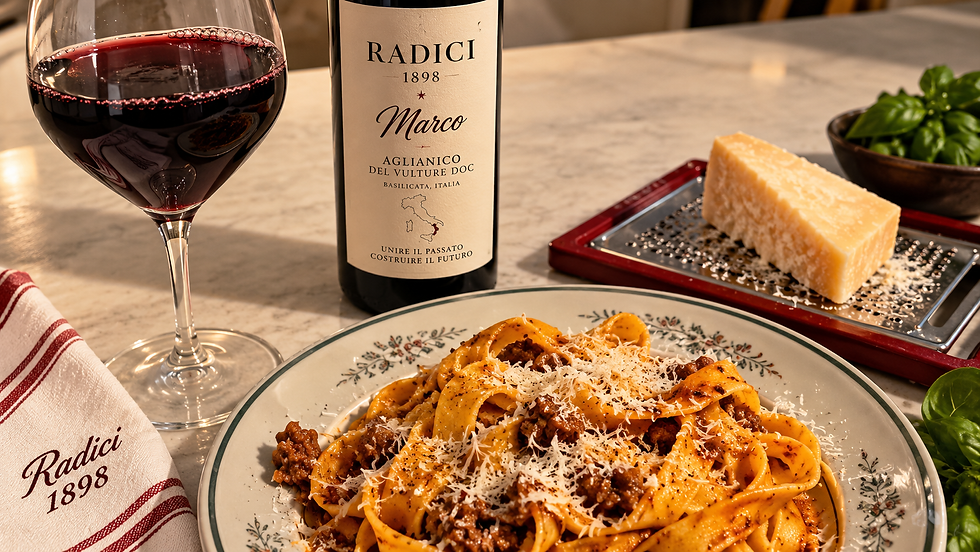
I was talking with my cousin Valentina in Italy about food and some of the differences she sees between the way things are eaten and prepared there and here—the ingredients, the preparation, the cooking methods, and even some of the little things that don’t necessarily make it into a recipe.
She mentioned that she makes the dish we were talking about and told me she’d teach me how she does it.
I probably should have waited. Instead, I went rogue.
Somewhere along the way, making dinner turned into making everything. The pasta? By hand. The ragù? From scratch. Then, because apparently I hadn’t created enough work for myself, I decided making fresh mozzarella sounded like a good idea too.
Several hours later, there was flour everywhere, pots covering the stove, dishes stacked in the sink and a kitchen that looked like something had gone terribly wrong.
The ragù was excellent. The pasta came out pretty damn good.
The mozzarella? It tasted good, but let’s just say nobody in Campania needs to worry about me going into the mozzarella business anytime soon.
By the time I finished eating and cleaning up the disaster I had created, it was around one in the morning.
But somewhere in the middle of all that chaos, I started thinking about something:
What actually makes food authentic?
I’ve spent 27 years as a licensed sports nutritionist, and I’ve spent even longer around Italian-American food. So food isn’t exactly new territory for me.
But the more time I’ve spent in Italy and the more connected I’ve become with family there the more I’ve found myself questioning things I never really questioned before.
Not just what’s in something, but where it came from. Where was the wheat grown? Where did the tomatoes come from? Who grew the olives? Who made the wine? And how much of what we think we’re buying is actually what we think we’re buying?
That last question has sent me down a few rabbit holes.

An Italian Flag Doesn’t Tell the Whole Story
Here’s one that surprised me: “Made in Italy” doesn’t necessarily mean the wheat in your pasta was grown in Italy.
Pasta can be produced in Italy using wheat grown elsewhere. Italian labeling rules actually distinguish between where the wheat was cultivated and where it was milled.
I never really thought much about that before. Now I can’t stop thinking about it.
Because if I’m choosing Italian pasta specifically because I care about its origin, shouldn’t the wheat be part of that story?
That’s one reason 100% Italian-grown wheat matters so much to what we’re developing with Radici.
It’s not because I believe everything grown in Italy is magically perfect. After 27 years in nutrition, I’ve watched too many miracle foods and nutrition trends come and go to make claims like that.
But I’ve heard the same thing over and over from people who travel to Italy: they ate the pasta, they ate the bread, they drank the wine—and they felt great.
There isn’t one simple explanation for that. Ingredients, agricultural practices, processing, preparation, portions, lifestyle and plenty of other factors can all play a role.
But I don’t dismiss the conversation anymore.
It makes me curious.
And lately, curiosity has been causing me a lot of trouble.
Just ask my mozzarella.
Simple Isn’t the Same as Easy
That night in the kitchen reminded me of something else I love about Italian food. The best dishes often aren’t complicated, but when something is simple, quality has nowhere to hide.
Good ingredients matter. So does technique. You don’t need fifteen ingredients when five good ones are doing their jobs.
And maybe that’s what convenience sometimes leaves behind not just quality, but knowledge. Someone knowing when the dough feels right. A recipe everybody in the family knows without ever writing it down. A cousin in Italy saying she’ll show you how she makes something, and you being too impatient to wait.
I’ve found myself asking questions I probably should have asked years ago: How did they make this? Where did it come from? Who taught them? And who’s going to know how to do it when they’re gone?
That’s the part of authenticity nobody can certify with a label.
And then wine taught me essentially the same lesson.

The Grape and the Place
Take Aglianico.
Aglianico is a grape. It’s grown in Basilicata, Campania and elsewhere in Southern Italy. There are excellent Aglianico wines outside Basilicata.
But they aren’t Aglianico del Vulture.
That difference matters.
Aglianico tells you the grape. Aglianico del Vulture tells you the place.
Vulture means Basilicata. It means the land around Monte Vulture, its volcanic origins, the vineyards, the growers and generations of knowledge associated with making wine there.
Aglianico grown in Campania has its own identity and its own story. But it isn’t Vulture. And Vulture shouldn’t be reduced simply to the name of the grape.
That’s when something clicked for me.
The difference between pasta made in Italy and pasta made from 100% Italian-grown wheat isn’t so different from the distinction between Aglianico and Aglianico del Vulture.
One tells you part of the story.
The other takes you closer to the source.
And that’s where I want Radici to live.
Not in buzzwords. Not in pretending everything Italian is automatically better simply because it’s Italian. And not in attacking every commercial product that does things differently.
I’d rather do something much simpler.
Show you the source.
If we’re talking about pasta, let’s talk about the wheat. If we’re talking about passata, let’s talk about the tomatoes. If we’re talking about olive oil, let’s talk about the olives. If we’re talking about wine, let’s talk about the vineyards and growers behind it.
And if we’re talking about Basilicata, let’s actually tell the story of Basilicata—not some generic version of Italy that could come from anywhere.
Italy isn’t one place. Its food isn’t one cuisine. Its wines aren’t interchangeable. Its traditions aren’t interchangeable.
I think those differences are worth understanding. And worth protecting.
Maybe That’s What Radici Really Means
Radici means roots.
The longer I work on this project, the more that word seems to grow.
Roots are family, but they’re also the things people teach us, the things a place produces, and the traditions somebody cared enough to carry forward.
They’re the knowledge behind a recipe, the work behind a harvest, the relationship between a grape and the land where it grows.
And yes, occasionally roots look like a grown man standing in a destroyed kitchen at one o’clock in the morning wondering how making dinner somehow turned into making cheese.
I can laugh about that. I do.
But underneath all of it is something I increasingly believe
We should know where things come from.
Our food, our wine, our traditions and ourselves.
Not because everything from the past was better. And not because authenticity means everything has to remain frozen in time.
It means understanding what came before us well enough to recognize what is worth carrying forward.
That’s what I want Radici to stand for.
There are still a lot of things I don’t know. Pasta led me to wheat. Wine led me to vineyards. Olive oil has opened an entirely different rabbit hole.
And apparently, I still have some unfinished business with mozzarella.
Maybe that’s the best part.
Every answer seems to uncover another story, and I have a feeling we’re only getting started.
Authenticity begins at the source. But it survives through people.
— Marc Tauriello
Founder, Radici 1898
Unire il passato, costruire il futuro.
Comments